
Hyperliquid 是現在槓桿交易的所在地
 itsthecryptoguy02-03 18:39
Hyperliquid isn’t “competing” with Binance’s PerpDEX narrative anymore.
It’s absorbing it.
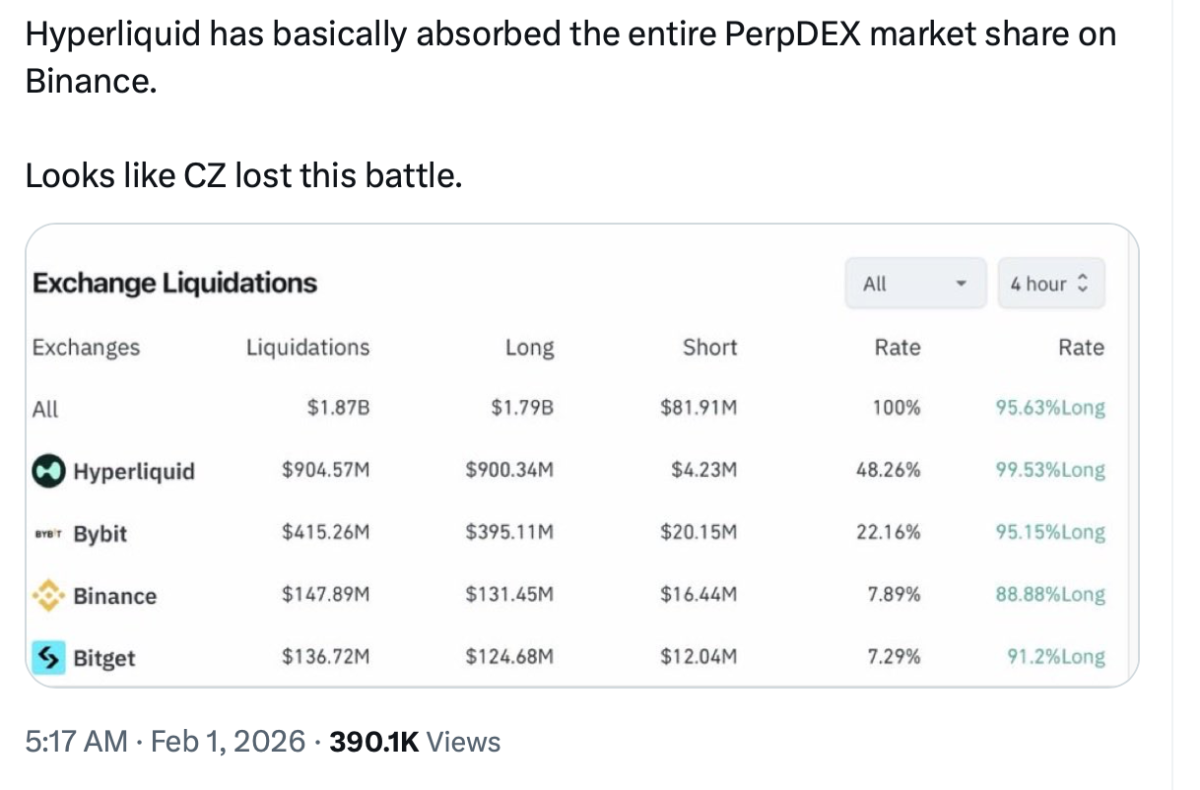
The liquidation data says the uncomfortable thing clearly:
Hyperliquid is now the dominant venue where leveraged pain is actually happening.
In a recent 4-hour window:
Total liquidations: ~$1.87B
Hyperliquid alone: ~$904M (~48% of all liquidations)
Bybit: ~$415M
That’s not a rounding error.
That’s not “DEX niche volume.”
That’s price discovery and leverage migration.
1. Volume doesn’t lie — this is where traders actually are
Liquidations are a brutal but honest metric:
They only happen where real size is traded
They correlate with deep liquidity
They show where directional traders trust execution
If nearly half of global liquidations are hitting Hyperliquid in a short window, that means:
Traders are opening size there
Stops and liquidations are being triggered there
The market cares what happens there
At that point, arguing about “DEX vs CEX” is missing the plot.
2. Market share: this is how Binance actually loses ground
Let’s be precise and not emotional.
Binance hasn’t “lost everything.”
But it has lost the PerpDEX narrative battle.
What we’re seeing:
The most mobile traders (perps, leverage, fast rotation capital) have moved
Liquidation density — the heart of derivatives trading — is no longer centered on Binance
Hyperliquid has become the default onchain venue for leveraged expression
This is how erosion starts:
Not by killing Binance’s spot dominance
But by draining the highest-velocity, highest-fee users
If you lose those users, you don’t collapse —
you slowly stop being the center of gravity.
That’s why people are saying:
“Looks like CZ lost this battle.”
Not the war.
But this battle? Yeah — the data backs that up.
3. Prediction markets: why outcome trading is a multiplier, not a side quest
Now layer in general-purpose outcome trading (HIP-4), and this gets more interesting.
Outcome contracts:
Fully collateralized
Explicit max profit / max loss
Binary or digital-option style
No leverage, no margin calls, no liquidation cascades
Strategically, this does two things:
It brings in new traders who don’t want perps
It keeps existing traders inside the same ecosystem
Perps for expression.
Outcome markets for conviction.
That’s how platforms stop being “one-product venues” and start becoming financial hubs.
4. The shadow narrative: core code theft
Now the tension point.
As Hyperliquid’s influence grows, core code theft allegations keep resurfacing:
Claims of architectural similarity
No conclusive proof
No legal resolution so far
So far, the market response has been simple:
Traders don’t care
Volume hasn’t slowed
Liquidity hasn’t blinked
But this will matter more if Hyperliquid:
Pushes deeper into prediction markets
Attracts institutions
Becomes systemically important onchain
Right now it’s background noise.
Later, it could be a gating factor.

Hyperliquid 是現在槓桿交易的所在地

Hyperliquid isn’t “competing” with Binance’s PerpDEX narrative anymore.
It’s absorbing it.
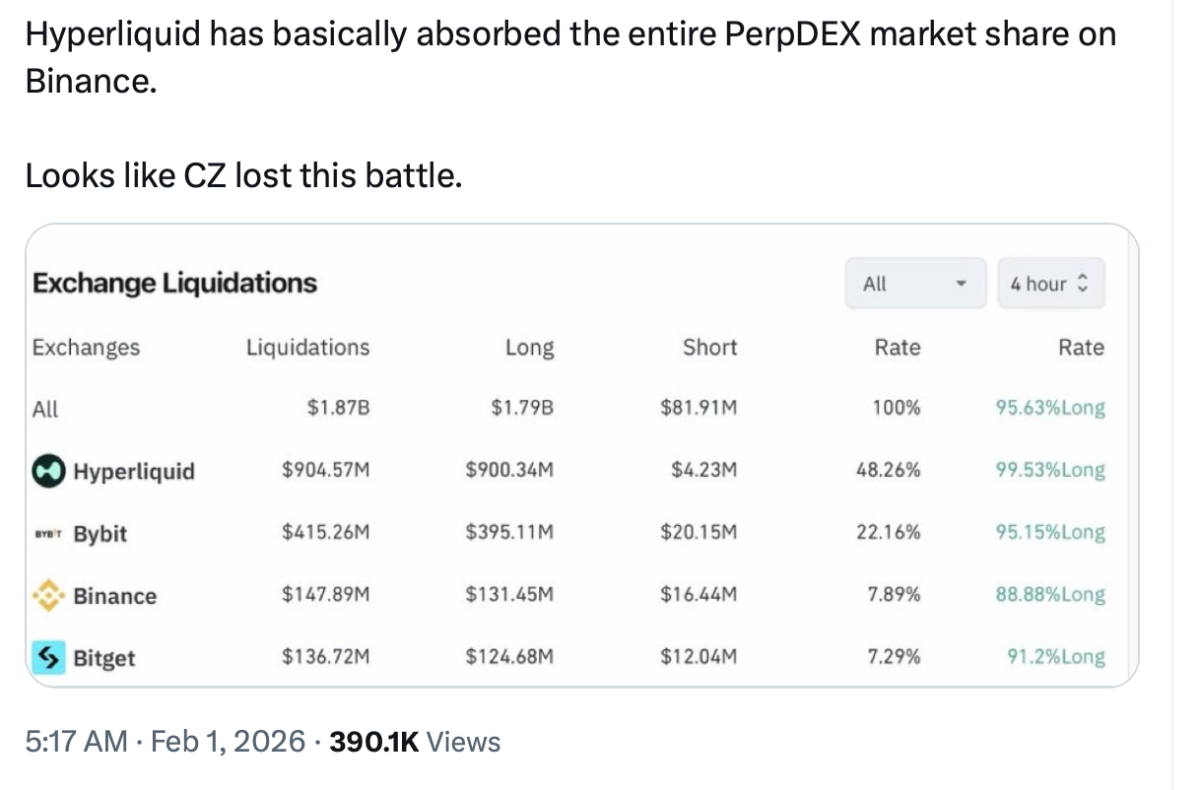
The liquidation data says the uncomfortable thing clearly:
Hyperliquid is now the dominant venue where leveraged pain is actually happening.
In a recent 4-hour window:
Total liquidations: ~$1.87B
Hyperliquid alone: ~$904M (~48% of all liquidations)
Bybit: ~$415M
That’s not a rounding error.
That’s not “DEX niche volume.”
That’s price discovery and leverage migration.
1. Volume doesn’t lie — this is where traders actually are
Liquidations are a brutal but honest metric:
They only happen where real size is traded
They correlate with deep liquidity
They show where directional traders trust execution
If nearly half of global liquidations are hitting Hyperliquid in a short window, that means:
Traders are opening size there
Stops and liquidations are being triggered there
The market cares what happens there
At that point, arguing about “DEX vs CEX” is missing the plot.
2. Market share: this is how Binance actually loses ground
Let’s be precise and not emotional.
Binance hasn’t “lost everything.”
But it has lost the PerpDEX narrative battle.
What we’re seeing:
The most mobile traders (perps, leverage, fast rotation capital) have moved
Liquidation density — the heart of derivatives trading — is no longer centered on Binance
Hyperliquid has become the default onchain venue for leveraged expression
This is how erosion starts:
Not by killing Binance’s spot dominance
But by draining the highest-velocity, highest-fee users
If you lose those users, you don’t collapse —
you slowly stop being the center of gravity.
That’s why people are saying:
“Looks like CZ lost this battle.”
Not the war.
But this battle? Yeah — the data backs that up.
3. Prediction markets: why outcome trading is a multiplier, not a side quest
Now layer in general-purpose outcome trading (HIP-4), and this gets more interesting.
Outcome contracts:
Fully collateralized
Explicit max profit / max loss
Binary or digital-option style
No leverage, no margin calls, no liquidation cascades
Strategically, this does two things:
It brings in new traders who don’t want perps
It keeps existing traders inside the same ecosystem
Perps for expression.
Outcome markets for conviction.
That’s how platforms stop being “one-product venues” and start becoming financial hubs.
4. The shadow narrative: core code theft
Now the tension point.
As Hyperliquid’s influence grows, core code theft allegations keep resurfacing:
Claims of architectural similarity
No conclusive proof
No legal resolution so far
So far, the market response has been simple:
Traders don’t care
Volume hasn’t slowed
Liquidity hasn’t blinked
But this will matter more if Hyperliquid:
Pushes deeper into prediction markets
Attracts institutions
Becomes systemically important onchain
Right now it’s background noise.
Later, it could be a gating factor.

 00:00
00:00